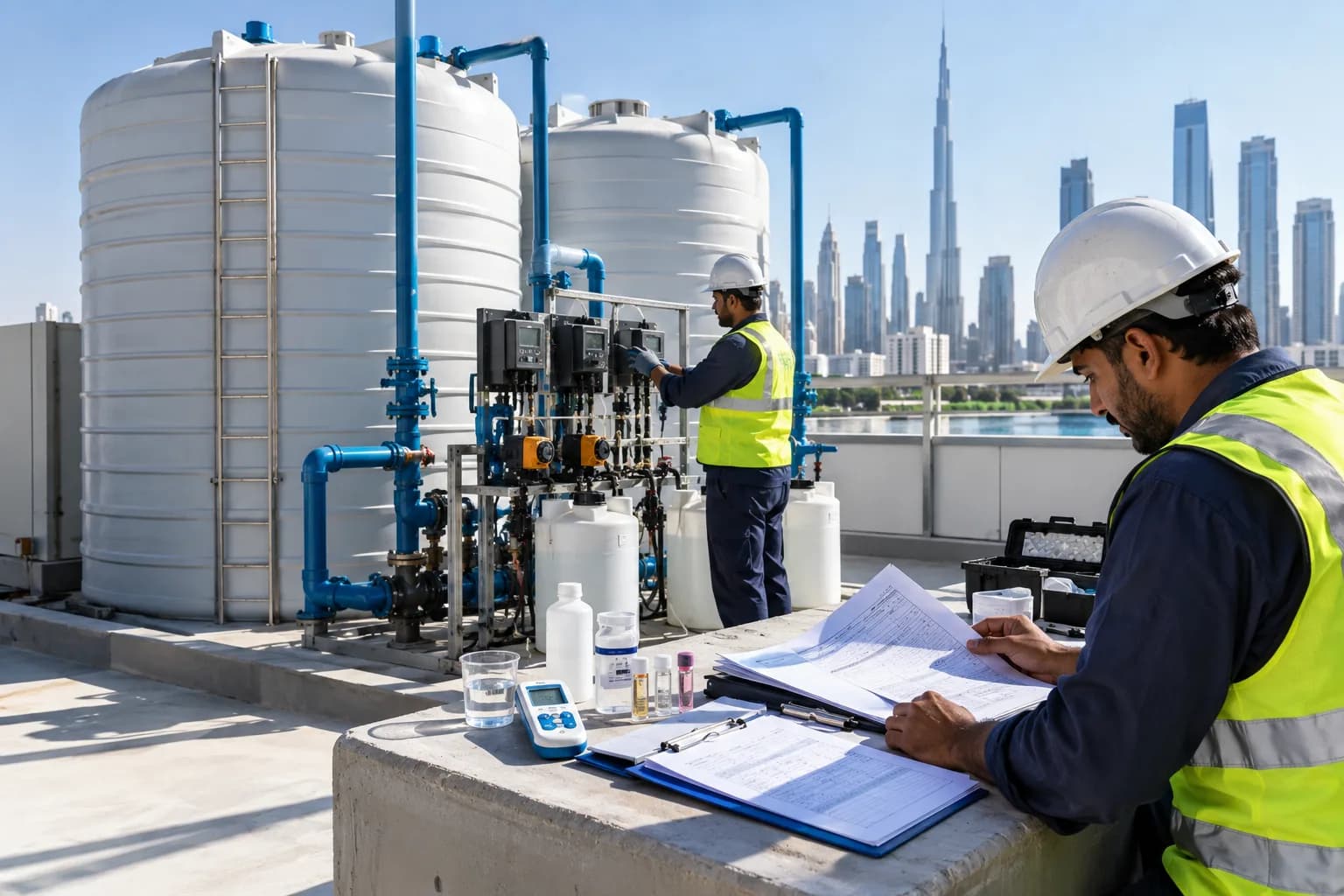
Every building in Dubai with stored water has a tank cleaning obligation, discharged by an approved contractor at a set frequency, with records kept. It is the most routine line on a maintenance schedule. It is also, in our audit experience, the line most likely to be technically incomplete — usually because the cleaning happened and the evidence did not.
What a compliant tank service actually consists of
Plan the outage
Notify occupants, arrange alternative supply or a low-demand window, isolate the tank, and confirm the building can run on the remaining compartment. Two-compartment tanks exist for exactly this reason — a single-compartment tank turns cleaning into a shutdown.
Drain, inspect, record condition
Photograph the internal condition before cleaning: sediment depth, biofilm, corrosion, coating failure, insect or vermin ingress, light ingress, screen and vent condition, and the state of the access hatch seal.
Mechanical cleaning
Remove sediment and biofilm physically. Chemical disinfection does not substitute for mechanical removal — biofilm shields organisms from the disinfectant.
Disinfection
Disinfect at the specified concentration for the specified contact time, then flush until residual is back within the acceptable range. Record concentration, contact time and the flush result — a disinfection with no contact time recorded is not evidenced.
Sampling and laboratory analysis
Post-disinfection samples analysed by an accredited laboratory, from defined points, with chain of custody. Retain the report against the tank asset, not in a general folder.
Defect report and close-out
Any coating damage, failed screen, missing vent cover, or light ingress goes on a dated defect list with an owner. Otherwise the same defect appears in the next report, unchanged.
The thing that matters more than chlorine: temperature
In UAE conditions the dominant bacterial risk driver is temperature. Cold water stored or distributed through hot voids and uninsulated risers drifts into the range where organisms multiply. Hot water systems held below their design temperature to save energy, or with long dead legs from oversized loops, do the same at the other end.
- Cold water: keep it cold. Insulate properly, route away from hot services, and check actual delivered temperature at outlets — not the tank.
- Hot water: store and circulate at the design temperature, and manage scald risk at the point of use with thermostatic mixing rather than by lowering storage temperature.
- Turnover: stagnation is the enemy. Size storage for the real demand, and flush low-use outlets on a schedule — unoccupied units, guest rooms out of service, seldom-used showers.
- Dead legs: find and remove them. Every capped branch left from a fit-out change is a permanent stagnation point.
Solar pre-heat and heat-pump hot water systems deserve specific attention. Their storage often sits in a temperature band that suits neither efficiency nor bacterial control unless a pasteurisation cycle or a top-up strategy is designed in and actually enabled in the controls.
A water safety plan, not a folder of certificates
Certificates prove that a task happened. A water safety plan proves the building understands its own risk. The difference matters when something goes wrong, and it takes an afternoon to produce.
| Element | Contents | Owner |
|---|---|---|
| System description | Schematic, tanks, pumps, calorifiers, loops, materials, ages | FM / MEP contractor |
| Risk assessment | Stagnation points, temperature exposure, vulnerable occupants | Competent assessor |
| Control measures | Temperatures, turnover, flushing regime, dosing, insulation | Operations team |
| Monitoring schedule | What is measured, where, how often, tolerance | Operations team |
| Records | Cleaning, disinfection, laboratory results, temperature logs | FM, retained per requirement |
| Escalation | Trigger levels and the named person who acts | Building owner / FM lead |
Design decisions that make the next twenty years easier
- Two compartments minimum, each able to carry the building alone during cleaning.
- Access hatches, ladders and internal access that let a person clean the tank safely and be rescued from it.
- Insulated, screened, vermin-proofed and light-proofed as built — not retrofitted after the first inspection.
- Sample points at defined locations, permanently labelled.
- Level and temperature monitoring into the BMS, with alarms someone will actually see.
- Storage sized for real demand rather than a rule of thumb, so the water turns over.
Nobody is ever asked to prove the tank was clean. They are asked to prove that the building knew it was clean, when, and how.
One practical habit: put the tank register, the cleaning dates and the next-due dates on the same page as the fire system inspection dates. Statutory items missed are almost always the ones tracked somewhere nobody looks.