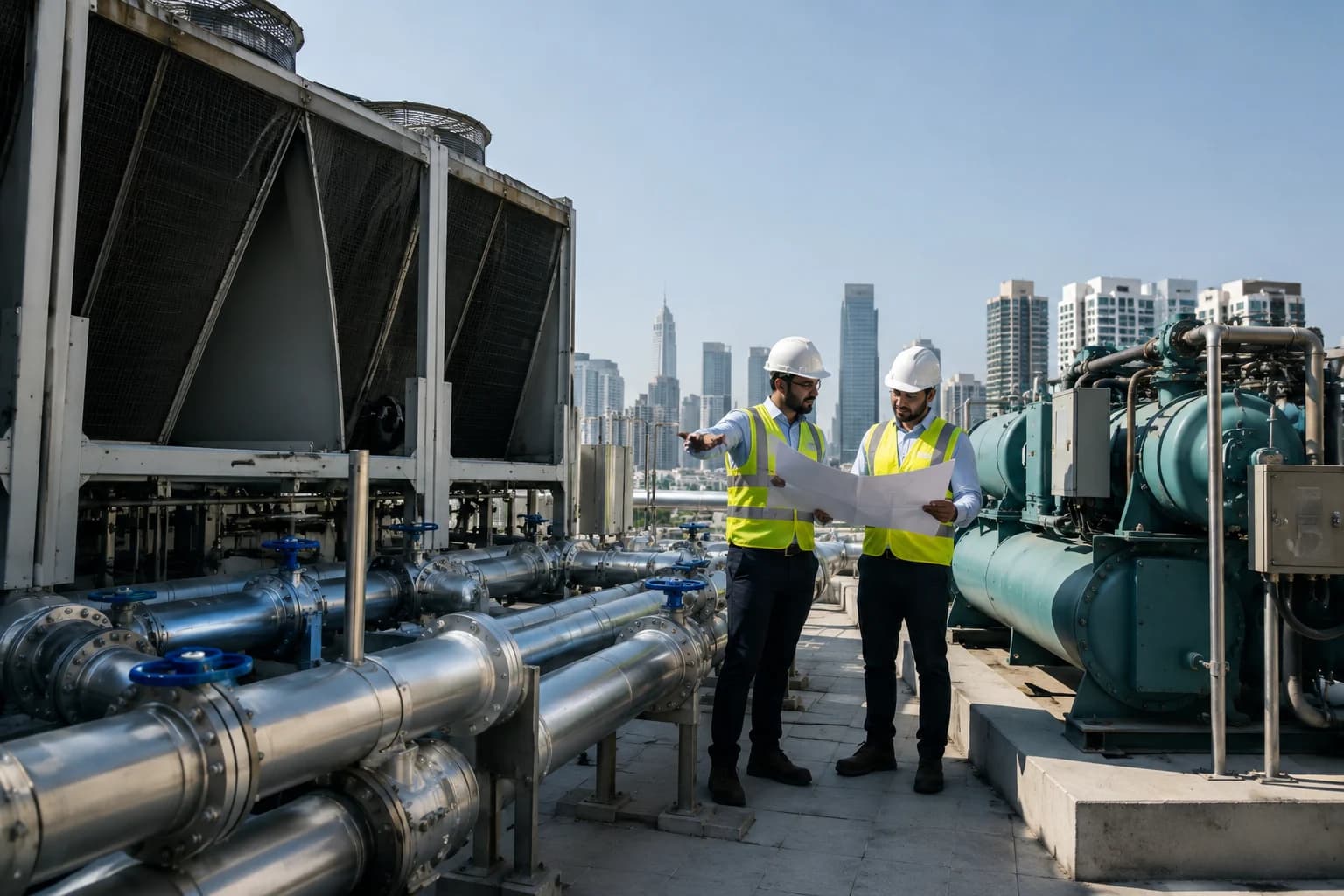
Testing, adjusting and balancing is the point at which a chilled water installation stops being a set of drawings and starts being a system with numbers attached. On a tall building it is also the point where a season's worth of small compromises becomes visible: the balancing valve installed too close to a bend, the test point behind a fire damper, the ceiling closed before the coil was reachable.
TAB does not go well or badly on the day. It goes well or badly six months earlier.
Design decisions that make balancing possible
Valve authority
A control valve sized to the pipe rather than to the pressure drop will not control. At low load it barely modulates, the coil sees near-constant flow, the return temperature drops and the system loses delta-T. Size two-port control valves on the pressure available across them, then check the authority figure. This is a five-minute calculation that saves a year of complaints.
Where the differential pressure is controlled
On a tall building the pressure profile between the plant room and the top floor is severe. Somebody has to decide how differential pressure is managed across the height — pressure-independent control valves, differential pressure control valves at branch level, or zone pumping. Left undecided, the lower floors are over-flowed and starve the top of the building, and no amount of balancing at the terminal will fix it.
Test points, straight lengths, access
- Straight pipe upstream and downstream of every measuring device, per the manufacturer's requirement — not what fits.
- Test points positioned where a person can reach them with a manometer while standing on something legal.
- Access panels sized for a hand and an instrument, not just for sight.
- Commissioning stations grouped at risers so a floor can be verified without opening every ceiling.
- Permanent labels fitted before the ceiling closes, not after.
Get the water clean first
Readings taken through a fouled strainer are fiction. Before balancing starts: flush to the specified velocity, clean and refit every strainer, chemically clean and passivate the system, dose the inhibitor, prove water quality by sample, and vent properly at every high point. Air in a coil looks exactly like a flow deficiency and wastes a day of everyone's time.
Record the water quality result with a date. If a coil underperforms in year two, that record is what distinguishes an installation defect from an operational one.
A sequence that avoids a second visit
Static completion, verified by the installer
Pressure tests passed, supports and anchors complete, insulation closed, valves accessible and labelled, strainers clean, system vented, pumps rotating correctly.
Set the plant room to a known condition
Pump curves proven, differential pressure sensors located and calibrated, control strategy loaded and understood. Balancing against an unstable plant is wasted effort.
Proportionally balance from the index circuit
Identify the index circuit, balance branches proportionally, then work down to terminals. Fix the total flow at the plant last, once the distribution is proportionally correct.
Balance at design flow, then check at part load
A system balanced only at full flow can still misbehave at thirty per cent. Verify behaviour at part load, which is where the building spends its life.
Prove delta-T across coils, not just flow
Flow is the means; temperature difference is the outcome. A coil at correct flow with a poor delta-T is telling you something about the coil, the air side or the valve.
Record as-left positions and lock
Every valve handwheel position, every setting, every reading, against a drawing reference. Then lock or cap what can be disturbed.
Air side and water side together
Air balancing changes coil load, which changes water side behaviour. Sequence them so the final witnessed readings are taken with both sides in their as-left state.
Tolerances, and how to talk about them
| Measurement | Typical target | What a miss usually means |
|---|---|---|
| Terminal water flow | Within the specified band of design | Valve authority, differential pressure control, or a partially blocked strainer |
| Coil delta-T | At or above the design difference | Coil selection, air-side flow, valve leakage or a bypass left open |
| Branch flow | Proportional across the branch | Index circuit misidentified, or an unbalanced riser |
| Pump duty | On the proven curve at measured head | System resistance differs from calculation — investigate before adjusting |
| Air flow at diffuser | Within the specified band, room totals correct | Duct leakage, damper position or a fan running off-curve |
Agree the tolerance and the measurement method with the consultant in writing before the first reading. Arguing about instrument accuracy after the fact is the least productive conversation available on a construction site.
What the report has to contain to be useful
- Instrument list with calibration certificates and dates.
- System schematics marked with every measurement location.
- Design, first-pass and as-left figures side by side — not just the final number.
- As-left position of every regulating and control device.
- Deviations, with the reason and the agreed disposition.
- Named witness signatures against each system.
A balance you cannot reproduce is a balance you do not have. The report is the system's baseline for the next twenty years.
That last point is the one operators care about most. When a floor complains in year three, the TAB report is the only evidence of what the system did when it was known to be right.