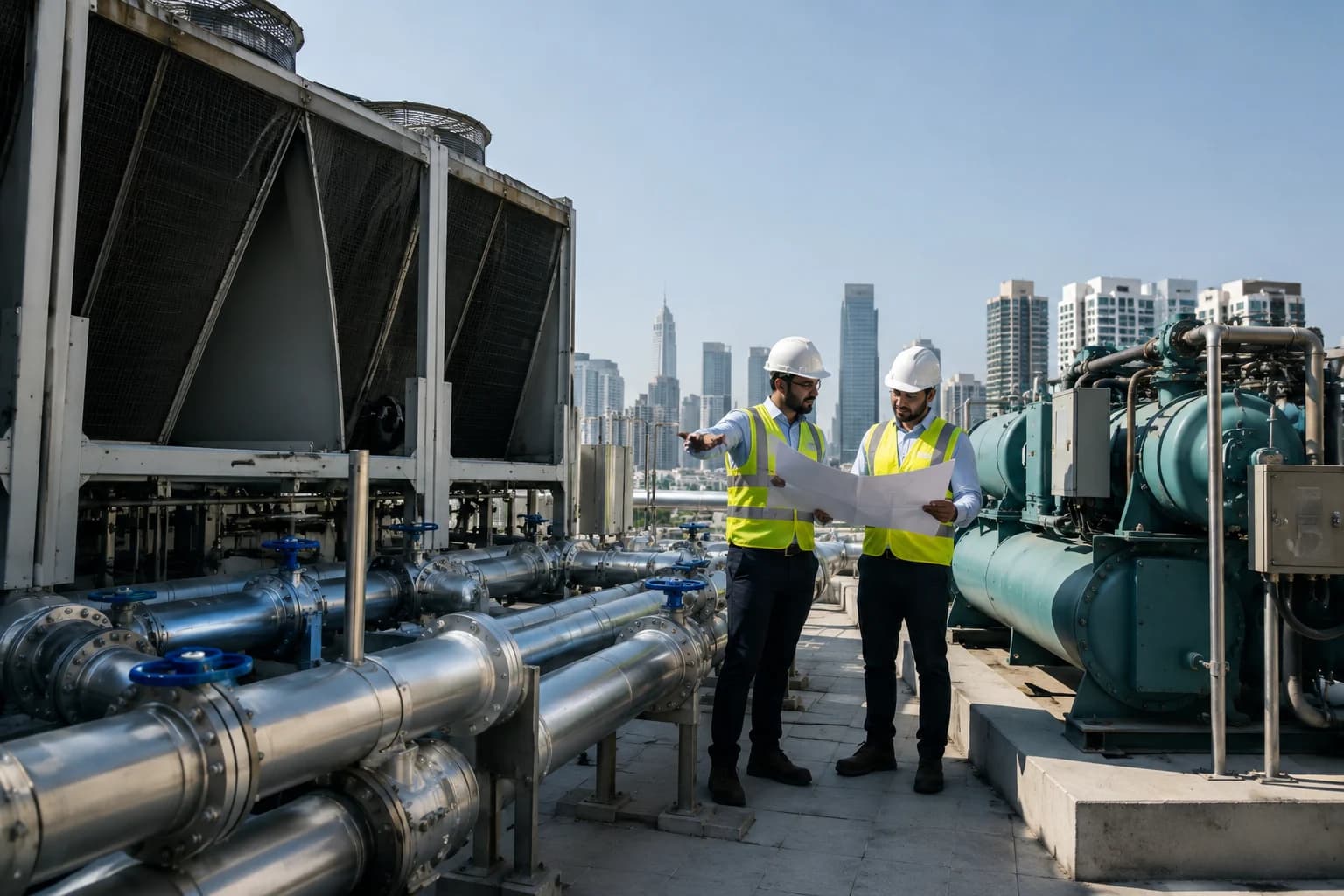
On most Dubai developments the cooling decision is taken early, at concept, on a single comparison sheet. District cooling shows lower capital cost and a smaller plant room; in-building chillers show lower running cost and independence. Both columns are usually right and both are usually incomplete.
Three factors move the answer more than the headline numbers do.
Factor one: what the released area is actually worth
A district cooling connection replaces a chiller plant, a cooling tower deck or air-cooled condenser platform, a condenser water system and its electrical infrastructure with an energy transfer station — typically a heat exchanger room with control valves, strainers and metering. On a tower that can free a meaningful slice of basement or roof, plus riser and electrical room space.
Whether that matters depends entirely on the asset. Released basement in a plot that is parking-constrained can be worth more than the entire cooling cost differential. Released roof on a hotel becomes usable amenity. Released area on a plot with spare basement is worth close to nothing. Ask the developer to value it rather than describing it as an advantage.
There is a second-order effect worth naming: removing condenser water removes the cooling towers, and with them a make-up water demand, a chemical dosing regime, a legionella control obligation and a maintenance burden that lasts as long as the building.
Factor two: who carries the peak, and how it is billed
District cooling agreements generally split into a capacity element, tied to contracted or connected capacity, and a consumption element metered in cooling energy. The capacity element is the one that catches developments out, because it is usually fixed for a long term and set from a load figure declared before anyone knew the tenancy mix.
Cooling loads on Dubai buildings are diverse in a way that a peak-sum calculation does not capture. Orientation, occupancy patterns and fit-out programme mean the whole building rarely peaks at once. Over-declare, and the building pays a capacity charge on capacity it never uses — every month, for the life of the agreement.
With in-building chillers the same diversity question shows up as a sizing and staging decision, but you keep the ability to revisit it. You also keep the electricity tariff exposure, the plant replacement liability, and the operating team.
Factor three: your return temperature is your problem either way
This is the factor most often left off the comparison and the one that most often turns a good connection into an expensive one. District cooling economics depend on a wide temperature difference between supply and return. Agreements commonly set a minimum return temperature, with penalties or capacity reductions when the building fails to deliver it.
Low delta-T is an in-building failure, not a plant failure. The usual causes:
- Three-port valves and fixed bypasses that let supply water back into the return without doing work.
- Coils selected for a narrower delta-T than the connection agreement assumes.
- Oversized coils running at low load with valves barely modulating.
- Control valves without adequate authority, so flow varies little as the valve strokes.
- Bypasses left open after commissioning, or fitted permanently to protect a pump.
- Dirty or air-locked coils, and strainers nobody cleaned after flushing.
Fixing these after handover means opening ceilings across occupied floors. Preventing them means specifying all-variable-flow with two-port control valves, selecting coils against the contracted delta-T, sizing valves for authority rather than for pipe size, and treating the commissioning bypass strategy as a design decision with a named removal point.
A comparison sheet worth signing
| Line | District cooling | In-building chillers |
|---|---|---|
| Capital cost, cooling plant | ETS room, connection and metering | Chillers, pumps, heat rejection, electrical infrastructure |
| Area consumed | ETS room plus risers | Plant room, heat rejection deck, tank and switchroom |
| Area released — valued | Enter the developer's rate, not a description | Baseline |
| Running cost | Capacity charge plus metered consumption | Electricity plus water, chemicals and maintenance |
| Replacement liability | Provider's, for the plant | Owner's, on a 15–25 year cycle |
| Operating team | ETS and in-building systems only | Full plant operation and maintenance |
| Delta-T exposure | Contractual — penalties possible | Operational — shows up as pump energy and capacity |
| Flexibility if load changes | Contract amendment | Re-stage or add plant |
Where each one tends to win
District cooling tends to win on dense, area-constrained plots inside a scheme already served by a network, on residential and hospitality towers with strong diversity, and where the developer will not be operating the asset long term. In-building plant tends to win on standalone plots with spare area, on buildings with unusual load profiles or high resilience requirements, and where the owner-operator has both a maintenance capability and a long horizon.
What does not change is the in-building design discipline. On a district cooling connection, poor secondary-side design is paid for through the agreement. On your own plant, it is paid for in pump energy, in chiller staging and in complaints from the top floors. The coil selections, the valve authority and the commissioning strategy matter either way.
Nobody has ever regretted specifying two-port valves and coils selected against the real delta-T. Plenty of buildings are still paying for the alternative.